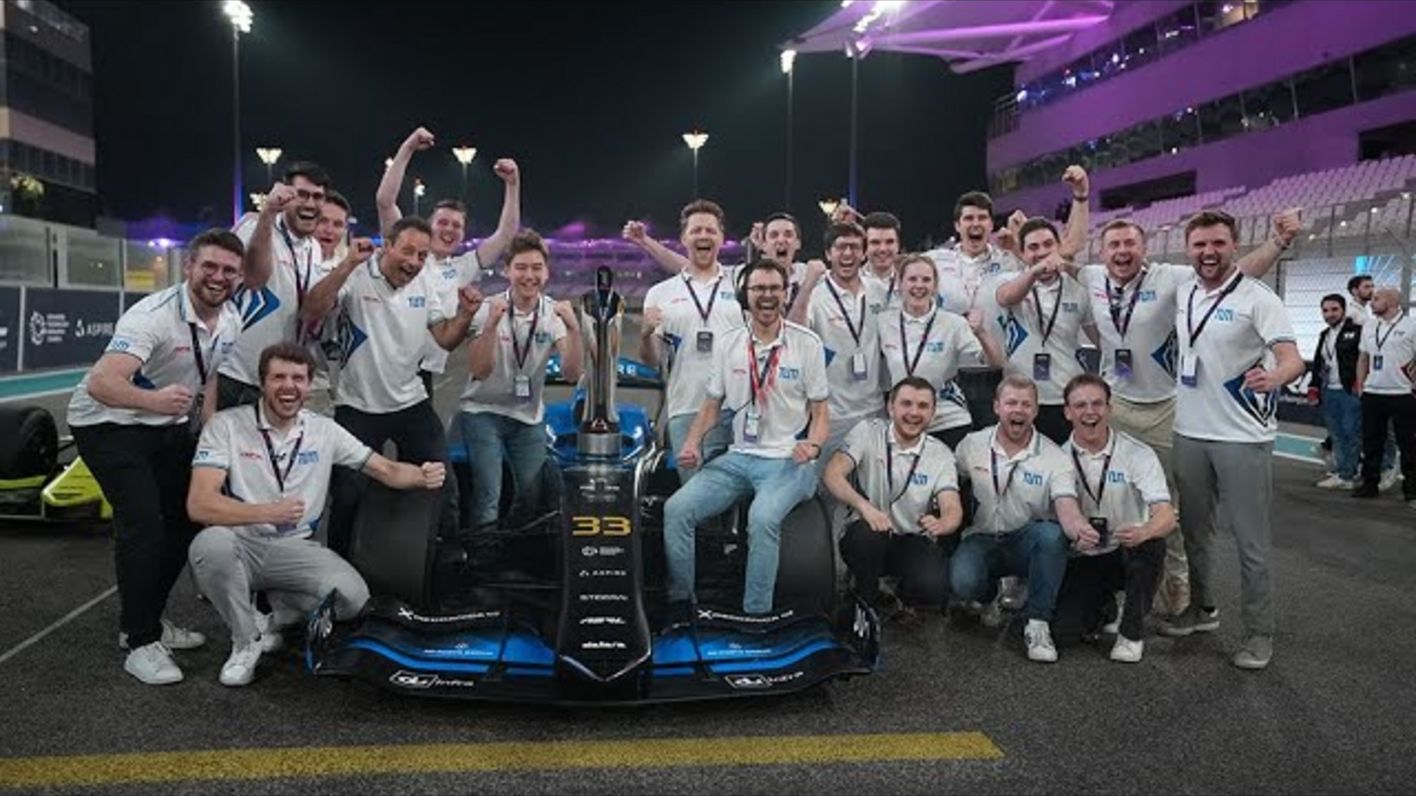
Triumph in Abu Dhabi: TUM Team Wins the Autonomous Racing League (A2RL)
NEWS |
The Future of Autonomous Racing
For over a week, with no more than four hours of sleep per night and with one clear goal in mind: winning the autonomous race. The 19-member TUM team from Germany, supported by three mechanics from Malaysia and the Philippines, poured their energy into one shared passion: fast, loud, and, in this case, autonomous race cars. In Abu Dhabi, they came together for the A2RL race format. Eleven teams from ten nations competed, plus a special head-to-head challenge: an exhibition race against former Formula 1 driver Daniil Kvyat.
Before the main race, several test days take place. At first, the TUM team is not eager to show everything they have. The vehicle accelerates cautiously, even though it can reach speeds of up to 250 km/h. The team sits inside one of the paddocks, massive garage spaces filled with the crackling sound of the engine on one side and the hum of computer systems on the other. In front of them: screens running algorithms and real-time track analysis. “The biggest technical challenge in autonomous racing is its complexity. You need to integrate sensors, localization, prediction, planning, and control – bringing all the technologies together into one system,” explains Prof. Markus Lienkamp.
That is precisely what TUM aims to achieve through the close collaboration of several chairs: the Chair of Automotive Technology (Prof. Markus Lienkamp), the Chair of Automatic Control (Prof. Boris Lohmann), and the Chair of Autonomous Vehicle Systems (Prof. Johannes Betz), as well as institutes such as TUM MIRMI. The team includes 15 PhD candidates and three master’s students.
A2RL, the Abu Dhabi Autonomous Racing League, is the largest event of its kind. “This project means a lot to TUM because, we can demonstrate our research, we can showcase innovation coming from Germany, and we can compete with other universities on an international level,” says Prof. Johannes Betz. For years, the researchers have been developing AI-driven strategies and preparing for this moment. “The biggest challenge right now is achieving human-like driving behavior – being as fast as a human, acting like a human, and ultimately competing at a human level,” Betz adds.
Man vs. Machine
Then the moment arrives: the first race begins. In a true “Man vs. Machine” moment, the TUM vehicle races against former Formula 1 driver Daniil Kvyat. While Kvyat is already sitting in the cockpit, mechanics Sukun Ahmad Ismail from Malaysia, known simply as “Botak” on the track, along with Giovanni Dellomes, “Gio”, from the Philippines, and a third colleague, prepare the autonomous vehicle at lightning speed. The car is lifted, tire warmers removed, wheels mounted. A warning light above the car flashes: once it stays lit, the track must be completely clear — too dangerous for anyone else. Only Kvyat is allowed to remain.
The human driver starts ten seconds behind the autonomous TUM car, “Hailey.” He quickly closes the gap. His best lap: 57.57 seconds. Hailey delivers 59.1 seconds – a time fast enough to qualify for Formula 1. “Our performance was impressive, but it also showed us that we still have a gap to human peak performance. But that’s exactly why we’re here: we want to learn, we want to explore what the algorithms are capable of at the moment, and then improve for the future”, says Simon Sagmeister, team leader of TUM Autonomous Motorsport.
Machine vs. Machine
Shortly afterward, the Grand Finale begins: A total of eleven teams had entered the competition, but only six vehicles advanced to the final. An AI head-to-head battle, especially against the team from Unimore in Modena, Italy. The two teams sit across from each other in the paddock as tension rises. After lap two, Unimore manages to overtake TUM on the left. The Italian side erupts in cheers, but only briefly. Hailey reduces the gap to 30 meters, attempting multiple overtakes over several laps. The researchers wait for the perfect moment, a moment the software does not yet identify flawlessly. By lap nine, the cars are only a few meters apart. Then both approach the last-place vehicle, which is driving very slowly and does not react. Unimore cannot avoid it – a collision occurs. Hailey, however, slips past on the inside of the corner and avoids damage.
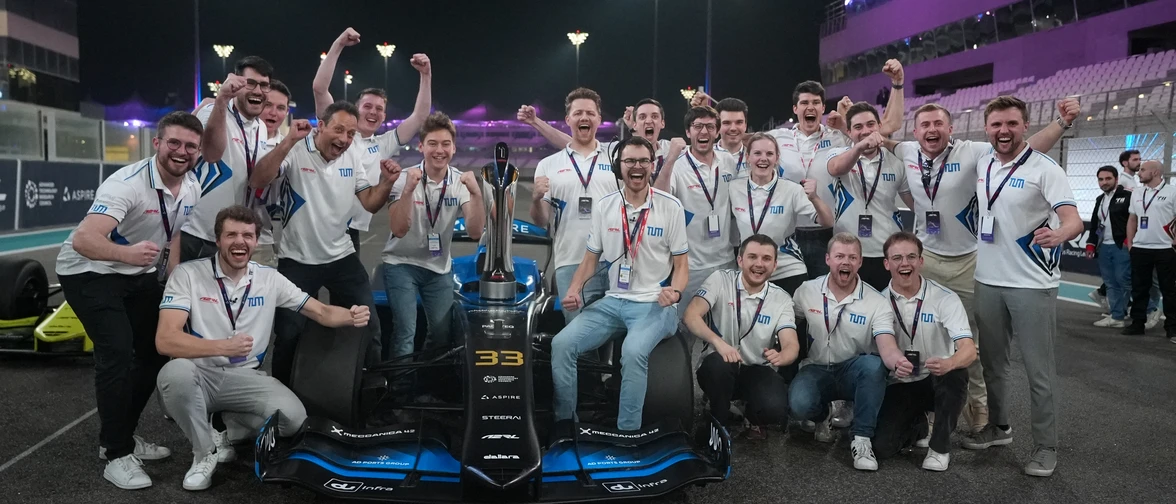
From that point on, TUM leads the field confidently. With a best lap time of 58.1 seconds, Hailey takes the victory, and with it, the entire TUM team.
“With this victory, TUM is sending a strong signal for the future of autonomous racing,” says Prof. Lienkamp.
Text: Sarra Chaouch-Şimşek